Inside Ethiopia’s Danakil Desert, Where Salt Is Still Cut by Hand and Transported by Camel

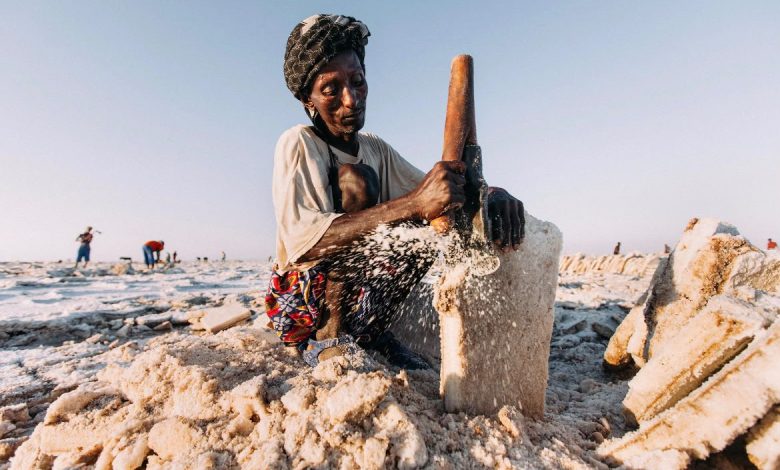
In one of the hottest and most extraordinary landscapes on Earth, Afar salt workers continue a centuries-old tradition of extracting blocks of salt from the desert floor using simple hand tools. The trade, which once played an important role in Ethiopia’s economy, remains a remarkable example of how traditional knowledge, natural resources and human ingenuity have shaped African livelihoods.
Deep in northeastern Ethiopia, within the vast and unforgiving landscape of the Danakil Depression, an unusual industry continues to attract attention. Here, in a region characterised by volcanic formations, enormous salt plains and extreme temperatures, workers extract salt directly from the earth using traditional methods that have survived for generations.
Unlike modern industrial salt production, where large machinery and automated systems are commonly used, the traditional salt industry around Lake Assale relies heavily on human labour, hand tools and, in some parts of the trade, camel caravans.
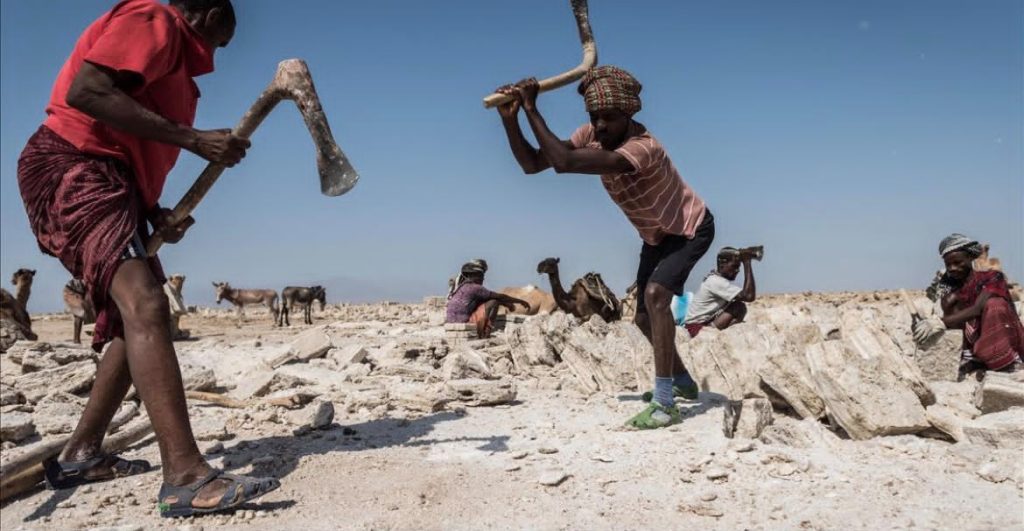
The workers, many of whom belong to the Afar community, travel to the expansive salt flats, where they break open the hardened surface, cut the underlying salt into manageable pieces and shape them into rectangular blocks for transportation and sale.
It is a remarkable scene: men working across an enormous white landscape, carefully cutting salt from the ground while loaded camels gather nearby, preparing for journeys that have connected Ethiopia’s desert communities with the country’s highland markets for centuries.
The Danakil Depression: One of Earth’s Most Extraordinary Landscapes
The Danakil Depression is located in the Afar Region of northeastern Ethiopia, extending towards neighbouring Eritrea and Djibouti. It forms part of the Afar Triangle, a geological region where three major tectonic plates meet and gradually move apart.
The area is particularly famous for its extreme environmental conditions. Much of the depression lies below sea level, and temperatures can become exceptionally high, with daytime conditions regularly exceeding 40°C in some locations.
Rainfall is scarce, the terrain is harsh, and much of the landscape consists of salt flats, volcanic formations and mineral-rich deposits.
One of its most remarkable features is Lake Assale, also known as Lake Asale or Lake Karum. The lake is surrounded by extensive salt deposits that have supported a traditional mining and trading industry for centuries.
The salt deposits are associated with the region’s geological history, including the evaporation of ancient bodies of seawater and the accumulation of minerals over long periods.
Although the landscape may appear lifeless at first glance, it has supported communities whose livelihoods have been closely connected to its natural resources.
How Salt Is Extracted From the Desert Floor
The traditional salt-harvesting process is one of the most fascinating aspects of the Danakil region.
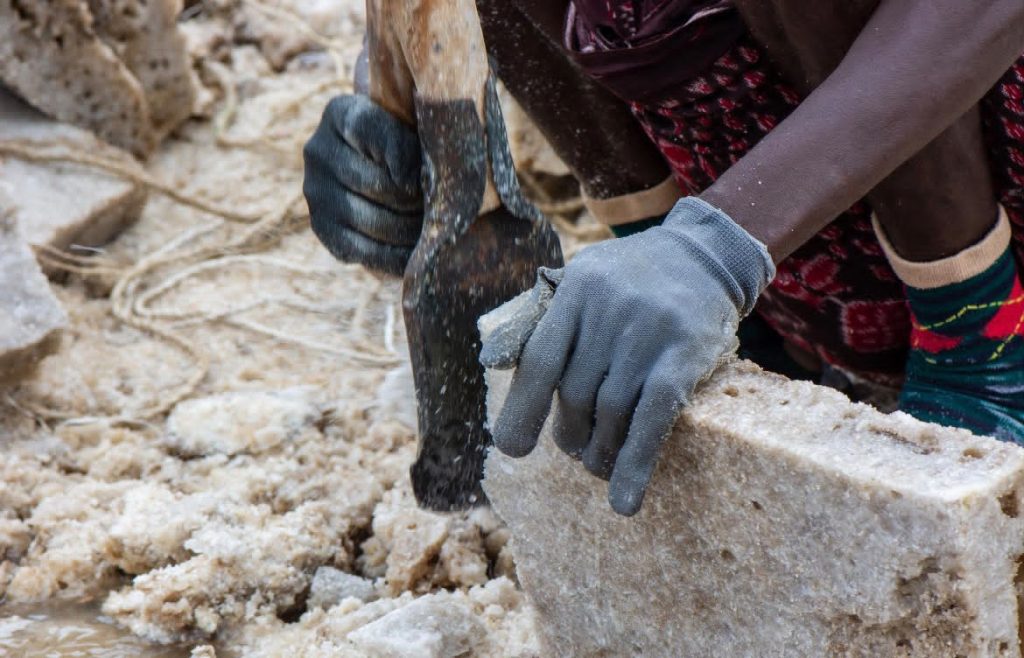
Rather than relying on heavy industrial machinery, workers use basic tools, including wooden poles, axes and hand implements, to separate the salt from the hardened surface.
The process generally involves several stages.
- Breaking the salt crust
Workers begin by breaking through the hardened upper layer of the salt flats. Using wooden tools and other hand implements, they loosen the surface and expose the thicker salt deposits underneath.
- Separating the salt slabs
Once the underlying salt layer is exposed, workers carefully separate large sections from the ground. This requires physical strength, experience and an understanding of how the salt deposits can be divided without unnecessarily breaking them into smaller pieces.
- Cutting and shaping the blocks
The extracted slabs are divided into smaller, rectangular pieces using axes and other hand tools. The blocks are shaped into relatively standard sizes to make them easier to handle, transport and trade.
These traditional salt blocks are known as amole. Historical studies describe different standardised forms, including blocks weighing approximately four and eight kilograms.
- Preparing the salt for transportation
After shaping, the blocks are gathered and arranged for transportation. Depending on the quantity being moved and the available transport arrangements, they may be loaded onto camels or donkeys.
The process is labour-intensive, and the workers must operate in a landscape where shade and access to water are limited.
Why Camels Are Important to the Salt Trade
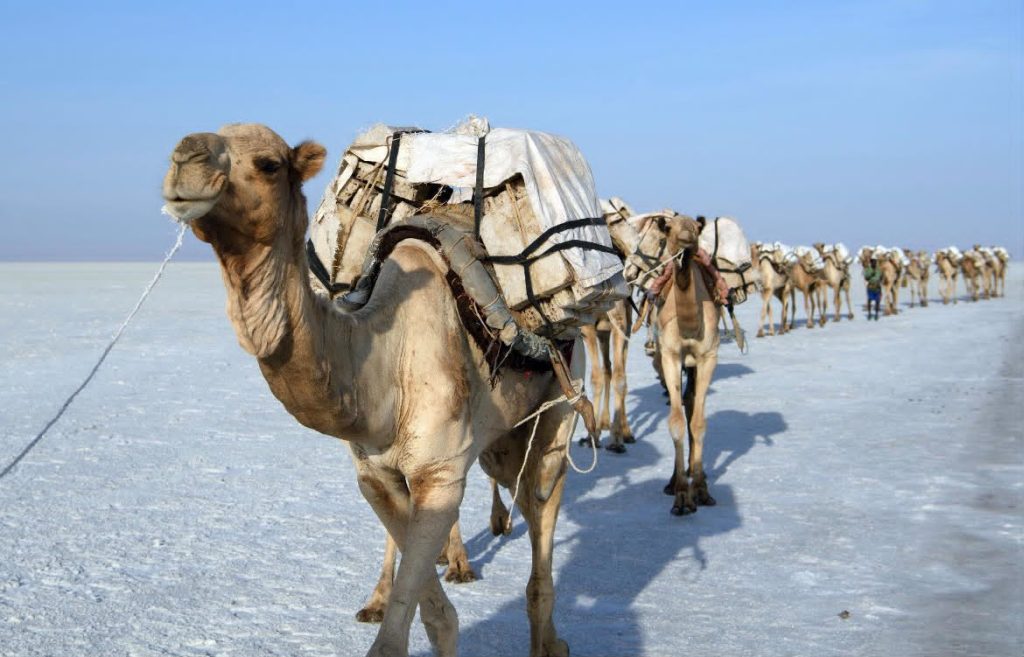
Perhaps the most recognisable feature of the Danakil salt industry is the use of camel caravans.
For centuries, camels have played an important role in moving salt from the low-lying desert mines towards settlements and trading centres in the Ethiopian highlands.
Their ability to travel through dry environments and carry heavy loads makes them particularly useful in regions where conventional transportation has historically been difficult.
After the salt blocks are prepared, they are loaded onto the animals, which travel along established routes towards settlements such as Berhale.
From there, the salt can move onwards towards larger markets, including those in the Ethiopian highlands.
The traditional Afar salt route covers approximately 160 kilometres between the salt-producing lowlands and the highland trading areas. Parts of the journey involve considerable changes in elevation, taking traders and animals from below sea level towards the mountainous escarpments.
The journey is not simply a transportation exercise. It represents a network of economic and social relationships involving salt miners, caravan owners, animal handlers, traders, brokers and market communities.
However, the industry has been changing. Trucks and improved roads have gradually replaced some traditional camel transportation, particularly since the expansion of road access in the region. Camel caravans nevertheless remain an important symbol of the historic trade and continue to feature in accounts and documentation of traditional salt transportation.
A Trade That Dates Back Centuries
The Danakil salt trade is not a recent economic activity.
Historical and archaeological research has linked the movement of salt from the Afar lowlands to the Ethiopian highlands with commercial networks dating back many centuries.
A 2025 scholarly chapter by archaeologist Helina Solomon Woldekiros, titled Desert Wealth: Ethnoarchaeology of the Afar Salt Trade, 450 BCE–1600 CE, examines the historical importance of salt production and transportation in the region.
The research explains how salt connected communities living in the lowlands with agricultural populations in the Ethiopian highlands.
Salt was an essential commodity because it was needed for food preservation, dietary consumption and livestock management. Its importance made the desert deposits valuable far beyond the communities living closest to them.
In certain historical periods, salt blocks known as amole also served as a form of currency or medium of exchange in parts of Ethiopia.
This gave the salt trade an economic significance that extended beyond the simple sale of a mineral.
It helped establish commercial relationships between different communities, supported the movement of goods and contributed to the development of trading networks across the region.
The Afar People and Their Relationship With the Salt Industry
The traditional salt trade is closely associated with the Afar people, an ethnic community whose homeland extends across parts of Ethiopia, Eritrea and Djibouti.
The Afar have historically maintained livelihoods connected to pastoralism, livestock rearing, trade and the exploitation of natural resources.
For communities involved in salt production, the desert has provided an important source of income and economic activity.
The work requires knowledge passed down through generations, including how to identify suitable salt deposits, extract the material, shape it into blocks and organise transportation.
It also involves cooperation among different groups. While some workers concentrate on extracting and shaping the salt, others are involved in loading, transporting, storing and selling it.
The industry therefore represents more than a traditional occupation. It is part of a wider economic and cultural system that has connected communities across different parts of Ethiopia.
Why the Traditional Salt Industry Is Changing
Despite its long history, the Danakil salt trade has experienced significant changes as modern transportation and industrial production have expanded.
Road construction has made parts of the previously isolated region more accessible, allowing trucks to transport larger quantities of salt over shorter periods.
This has introduced new commercial opportunities but has also reduced the dependence on some traditional transportation methods.
A 2021 documentary research project titled Arho – The Afar Salt Trade of North-eastern Ethiopia examined the changing industry and the effects of modern transportation on communities involved in the traditional caravan trade.
The documentary, produced by Till Jakob Frederik Trojer, follows a camel caravan travelling to the salt plains and explores how changes in the industry affect the people whose livelihoods have depended on it.
The transition towards road transportation raises important questions about preserving traditional knowledge while allowing local communities to benefit from modern infrastructure and changing markets.
The future of the industry will depend partly on how traditional producers adapt to new commercial arrangements and whether the economic benefits of modernisation reach the communities that have sustained the trade for generations.
From Raw Salt to Everyday Products
Salt extracted from the Danakil Depression contributes to Ethiopia’s wider salt supply.
However, the blocks cut directly from the desert are not necessarily ready for direct consumption. They may require crushing, processing, cleaning and appropriate quality control before being marketed as edible salt.
Food-grade salt also needs to meet applicable safety and iodine-fortification requirements.
Iodisation is particularly important because iodine deficiency can affect normal thyroid function and brain development, especially during pregnancy and childhood.
Ethiopia has invested in improving salt iodisation and processing systems, recognising the importance of ensuring that salt reaching households meets public health requirements.
This connects the traditional mining industry with a much wider supply chain involving processors, distributors, traders and consumers.
A Remarkable Example of Africa’s Traditional Resource Economy
The salt workers of the Danakil Depression offer an extraordinary example of how African communities have developed economic systems around the natural resources available in their environments.
For centuries, the salt deposits around Lake Assale have supported mining, transportation and trade, connecting people living in some of Ethiopia’s most geographically different regions.
Today, the industry stands at an interesting point between tradition and modernisation. Industrial production, improved roads and motorised transportation are changing how salt is extracted and distributed, but the knowledge and practices associated with the traditional trade remain an important part of the region’s heritage.
The story of the Danakil salt industry is ultimately about more than salt. It is about the relationship between people and their environment, the value of indigenous knowledge, the development of ancient trade networks and the ability of communities to build livelihoods around natural resources.
In a world increasingly defined by automated production and advanced technology, the sight of workers cutting salt from the desert floor and the familiar image of camel caravans crossing the Ethiopian landscape provide a powerful reminder of the depth and diversity of Africa’s economic and cultural heritage.
The Danakil Depression is not simply a place where salt is found. It is a landscape where geography, history, human effort and commerce have been connected for centuries.
TNAM