Morocco Uses Training and Digital Tools to Expand Amazigh Public Services
The course aimed to enhance communication skills in Amazigh and strengthen the capacity of public servants to provide more inclusive and accessible services.

Morocco has taken another significant step towards strengthening linguistic inclusion and preserving its cultural heritage by advancing efforts to integrate the Amazigh language into public administration.
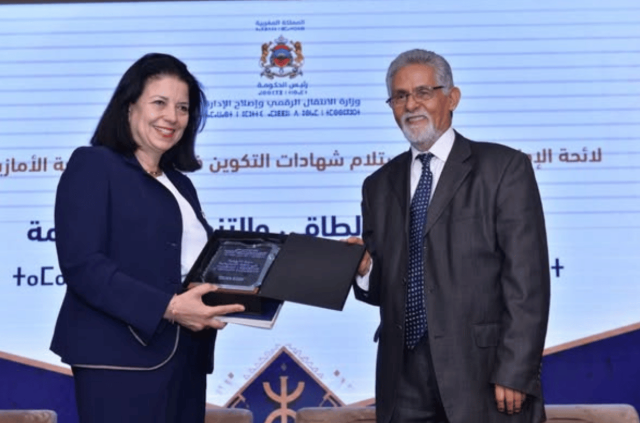
The move follows the conclusion of a specialised training programme designed to equip government employees with the skills needed to communicate effectively in Amazigh and deliver more inclusive public services. The initiative was highlighted during a meeting chaired by Minister of Digital Transition and Administration Reform, Amal El Fallah Seghrouchni, alongside Ahmed Boukous, Rector of the Royal Institute of Amazigh Culture.
Organised through a partnership between the Ministry of Digital Transition and Administration Reform and the Royal Institute of Amazigh Culture, the programme trained 120 public sector employees drawn from ministerial departments, constitutional institutions and various public establishments.
The training aimed to strengthen participants’ communication abilities in Amazigh, enabling them to better serve citizens and ensure that public services are accessible to a wider segment of the population.
Speaking at the event, Minister Seghrouchni described capacity building as a cornerstone of effective public administration. She noted that equipping civil servants with Amazigh language skills not only improves the quality of services but also reinforces the government’s commitment to bringing public institutions closer to the people they serve.
“Training remains an essential tool for developing human resources and enhancing the performance of public services,” she said, adding that the integration of Amazigh into administrative processes reflects Morocco’s determination to preserve and promote its rich cultural and linguistic diversity.
The minister also outlined the progress made under the government’s broader strategy to implement the official status of Amazigh within state institutions.
According to her, authorities have signed 73 partnership agreements with public institutions to support the initiative, while 25 sector-specific action plans have been developed to guide implementation across various sectors.
In addition, the government has introduced 491 guidance and reception tools in Amazigh within public administrations. The language has also been incorporated into telephone services and the visual identity of government institutions to make official communication more inclusive.
Efforts have extended to the translation of institutional content and the development of an administrative dictionary containing approximately 8,000 Amazigh administrative terms, aimed at standardising usage and facilitating communication within the public sector.
For his part, Ahmed Boukous underscored the significance of promoting Amazigh as an integral component of Morocco’s national identity. He stressed that the country’s language policy is founded on the principle of unity through diversity, recognising Amazigh as a shared cultural heritage that belongs to all Moroccans.
The event concluded with the presentation of certificates to participants, symbolising the continued collaboration between government institutions and cultural organisations in advancing linguistic inclusion and improving citizens’ access to public services.
As Morocco deepens efforts to give practical effect to the official status of Amazigh, the initiative stands as a reflection of the country’s broader commitment to cultural preservation, social inclusion and responsive governance in an increasingly diverse society.
TNAM
By Egwu Patience Nnennaya
Tuesday June 16, 2026.