North African oil giant challenges Dangote’s Fuel dominance
Dangote remains Africa’s largest refinery, but Algeria’s Sonatrach is strengthening its downstream position as competition for the continent’s growing fuel market intensifie

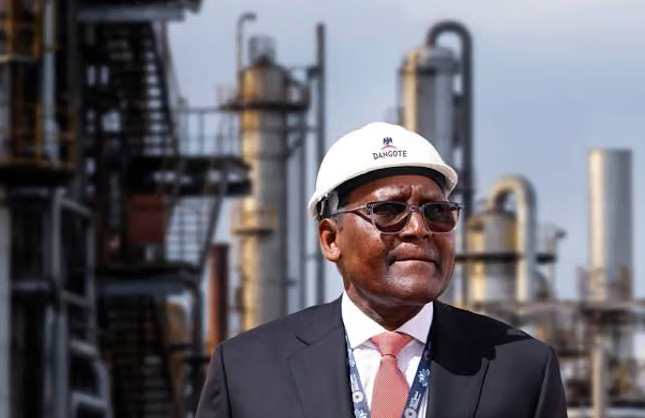
Africa’s refining industry is entering a new phase, with Nigeria’s Dangote Petroleum Refinery firmly established as the continent’s largest refining facility while Algeria’s state-owned Sonatrach continues to strengthen its position as one of Africa’s most important integrated energy companies.
The development is significant because Africa still imports a large share of the refined petroleum products it consumes, despite being home to some of the world’s major oil-producing countries. The expansion of local refining capacity is therefore becoming a strategic contest over who will supply the continent’s growing demand for petrol, diesel, aviation fuel and petrochemical products.
Dangote has changed West Africa’s fuel market
The Dangote refinery in Lagos has a nameplate capacity of 650,000 barrels per day, making it Africa’s largest refinery and the world’s largest single-train refinery. The facility reached its 650,000-barrel-per-day capacity in February 2026, marking a major turning point for Nigeria, which spent years depending heavily on imported refined petroleum products despite being one of Africa’s biggest crude-oil producers.
The impact is already visible across West Africa.
S&P Global reported that West African imports of clean refined petroleum products fell 23% in May 2026, to about 765,000 barrels per day, from 997,000 barrels per day in April. Analysts attributed the decline largely to the ramp-up of Dangote’s refinery.
Dangote has also moved aggressively into exports.
In March, the refinery exported 12 cargoes containing about 456,000 tonnes of refined petroleum products to markets including Côte d’Ivoire, Cameroon, Tanzania, Ghana and Togo. Nigeria subsequently became a net exporter of petrol in March 2026, with Dangote exporting about 44,000 barrels per day of petrol, according to reported industry data. The refinery also sent a 317,000-barrel petrol cargo to Mozambique, extending its reach beyond West Africa. That is a dramatic change for a country that previously imported much of the fuel it consumed.
While Dangote is the new giant on the African refining scene, Algeria has spent decades developing an integrated oil and gas industry around Sonatrach.
The company’s Skikda refinery has a capacity of approximately 356,500 barrels per day, making it one of the largest individual refineries on the continent and the second-largest after Dangote by refinery capacity. More broadly, Algeria has a substantial refining network. S&P Global’s African refining data places Algeria among the continent’s leading refining countries, with Sonatrach operating a number of facilities.
Sonatrach’s advantage is not simply the size of one refinery. It is the company’s integrated position across the energy value chain, from oil and gas production to refining, petrochemicals and energy exports.
That gives Algeria a different competitive model from Dangote. Dangote is using one enormous, highly integrated refinery to build a new regional fuel-export business. Sonatrach has an established national energy system and long-standing access to Algeria’s crude and gas resources.
One of the clearest areas where the two businesses are beginning to overlap is petrochemicals.
Dangote is developing a 400,000-tonne-per-year Linear Alkylbenzene (LAB) plant, a petrochemical facility that would significantly expand its downstream product portfolio. LAB is used in the production of surfactants and detergents.
That matters because Africa currently has only a small number of LAB production facilities.
Sonatrach already operates an LAB plant in Algeria with a capacity of about 100,000 tonnes per year, according to industry reporting. Egypt also has a facility of similar scale.
If Dangote completes its planned plant, Nigeria could therefore become a much larger player in Africa’s petrochemical market.
The competition is no longer simply about who sells petrol at the pump. It is increasingly about who can capture more value from crude oil by producing diesel, aviation fuel, lubricants, petrochemical feedstocks and other higher-value products.
Dangote’s ambitions extend well beyond its current 650,000-barrel-per-day operation.
The company is targeting an expansion to 1.4 million barrels per day, which would make the Nigerian facility larger than its current configuration and potentially the world’s largest refinery by capacity. Reuters reported this month that Dangote is planning to double its capacity within about three years.
The company is also looking beyond Nigeria.
Dangote has announced plans for a proposed 700,000-barrel-per-day refinery in Lamu, Kenya, which would become one of East Africa’s largest refining projects if developed as planned. The proposed facility is intended to supply Kenya and neighbouring markets and reduce the region’s dependence on imported fuel.
That expansion could eventually give Dangote a much wider footprint across Africa. But Dangote faces a major weakness: crude supply The biggest challenge to Dangote’s ambitions is not refining technology. It is securing enough crude at competitive prices.
Nigeria has abundant crude resources, but domestic refiners have repeatedly complained about difficulties obtaining sufficient local feedstock. Reuters reported on August 12, 2026 that the Nigerian government is considering reforms to crude-allocation and pricing rules to improve supplies to domestic refineries, including Dangote. Nigeria’s upstream regulator said compliance with domestic crude-supply obligations had improved to more than 90%, from below 43% previously.
Dangote has also had to supplement Nigerian crude with foreign supplies. That issue could become even more important if the refinery expands to 1.4 million barrels per day. The larger the refinery becomes, the more crude it will need to process consistently.
Africa’s fuel market is big enough for more than one giant, despite the rivalry, the numbers suggest that Africa still has room for additional refiners.
The continent produces large quantities of crude oil but has historically lacked sufficient modern refining capacity. Dangote’s arrival has reduced imports in West Africa, but it has not solved Africa’s wider refining deficit.
Other countries are also expanding their refining capabilities, including Egypt and Angola, while Algeria remains one of the continent’s most established downstream markets.
This means Africa’s emerging refining race should not necessarily be viewed as a simple Dangote-versus-Sonatrach battle. It is a much bigger shift: African countries are increasingly trying to process their own crude, supply their own markets and capture more of the value created by their natural resources.
The growing capacity of Dangote and Sonatrach could have major implications for African consumers and economies.
More local refining can reduce dependence on fuel imports, lower exposure to international shipping disruptions and create jobs in refining, logistics, engineering and petrochemicals. It could also strengthen intra-African trade.
Rather than importing fuel from Europe or other distant markets, African countries can increasingly buy from refineries within the continent. Dangote’s shipments to Ghana, Togo, Côte d’Ivoire and Cameroon are already an example of this emerging regional trade pattern.
At the same time, stronger competition between major refiners could force producers to become more efficient and competitive on pricing. For Nigeria, Dangote’s success offers an opportunity to transform the country from a crude exporter and fuel importer into a major refined-product supplier. For Algeria, Sonatrach’s established refining and petrochemical base gives it an important role in North Africa and Mediterranean energy markets.
And for the continent as a whole, the real prize is bigger than market dominance. It is the possibility of an Africa that exports more finished energy products instead of exporting crude and buying back the refined products at a higher cost.
Dangote currently holds the clear advantage in refinery size, while Sonatrach remains one of Africa’s most established integrated energy companies.
The two represent different models of African energy power: Dangote’s rapidly expanding private-sector industrial model and Sonatrach’s long-established state-backed energy system.
As both expand their downstream operations, competition for Africa’s fuel and petrochemical markets is likely to become more intense.
For African economies, however, the most important question will be whether that competition delivers more reliable fuel supplies, competitive prices, industrial jobs and greater value from the continent’s own natural resources.
TNAM
By Egwu patience Nnennaya.